
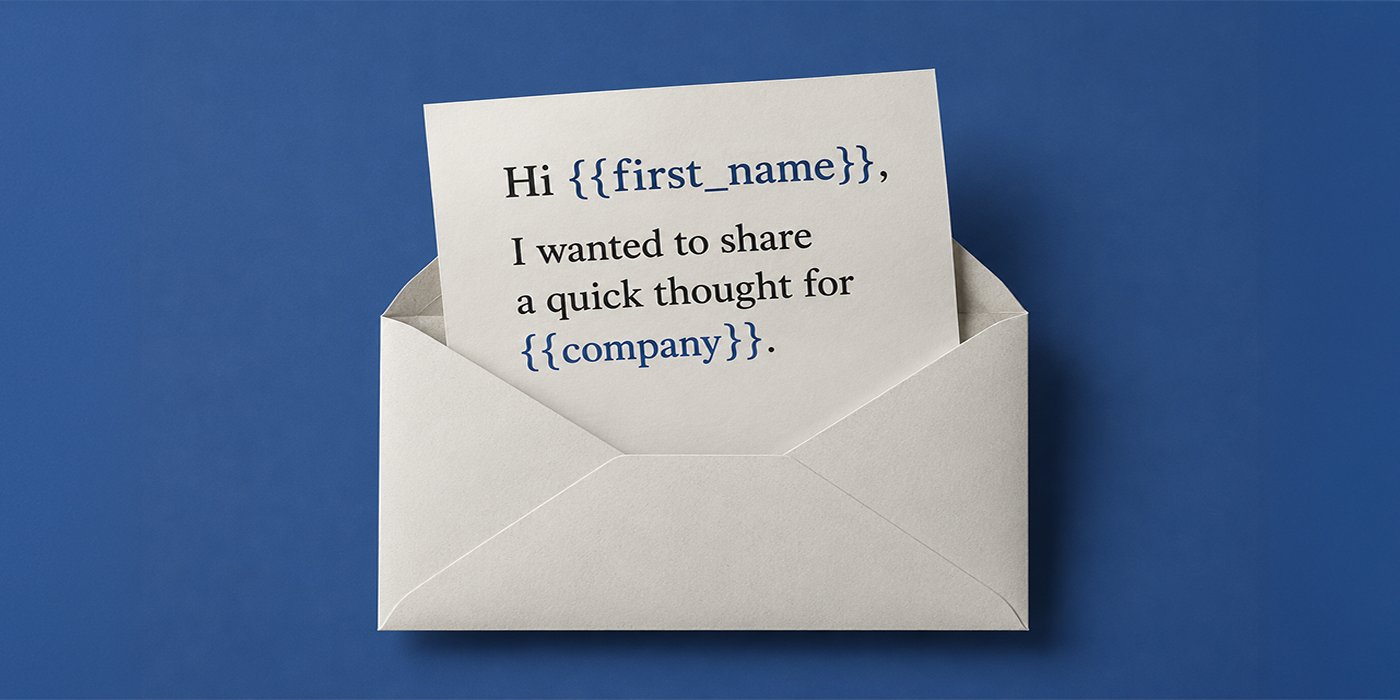
You built the account list. You researched the logos. You dropped {{first_name}} and {{company}} into the sequence and turned it on.
That is not account-based marketing. That is a mail merge with a shorter list.
And the person on the other end can tell in about half a second.
The first piece in this series made the case for why good ABM is worth doing: when you target the accounts you are genuinely built to serve, the customer wins before you do. This piece is about the part everyone skips. How you actually run it without fooling yourself into thinking volume-with-a-name-on-it counts.
Generic-to-a-named-account is worse when it becomes generic-at-scale
Spray-and-pray fails quietly. Nobody remembers the email they ignored.
But generic aimed at a named account fails loudly. You have just told a buyer “we singled you out, we studied you, you matter to us,” and then you proved the opposite in the same breath. You signaled effort and delivered a template. That does not read as neutral. It reads as a tell.
So you burn the one account you most wanted. And because you never mapped who actually had to be convinced inside that account, you cannot even see why the program is not converting. You are measuring a list, not a relationship.
A 0.2% wake-up call
A while back we worked with a B2B2C client with a large list of existing customers. We ran a send using a message that had worked well in another market. It converted at 0.2%, far below what we expected. The saving grace: we had not blasted all 80,000. We started with a slice.
So instead of pushing more volume, we did two things. We surveyed the recipients, and we interviewed the ones willing to talk. We asked two questions:
- What did you read that made you decide not to enroll?
- What did you not read that would have helped you decide to enroll?
The answers surfaced a tension we would not have guessed: brand awareness was low even though these were already customers. They did not connect the offer to a company they already did business with. That was the thing the campaign needed to say and was not saying.
We reworked it, added steps to the sequence, and conversions climbed to 0.8% to 1.2%. Same list. A far better grasp of what the reader actually needed to hear. It was not a textbook named-account program, but it taught the ABM discipline in miniature: start with a slice, find the specific thing this audience needs to hear, then earn the conversion.
The should-hurt test
Here is the bar that separates ABM from a narrow blast.
If your message could be sent to any other company in the segment, it is not ABM. And the inverse is the useful part: when you know an account well enough, the message should almost hurt. It names a tension the buyer has not said out loud yet. It is specific enough that reading it is a little uncomfortable, because it is clearly about them and not about people like them.
That is the feeling you are aiming for. Not “this is relevant to my industry.” Closer to “how do they know that.”
You cannot fake your way to that line with research tools alone. The fastest route we have found is the two questions from that campaign, asked of the people who did not act: what did you read that stopped you, and what did you not read that would have moved you. The answers hand you the tension to name. From there, it is a matter of treating ABM as a relationship-mapping and value-creation discipline, not a tighter targeting filter. Here is what that looks like in practice.
1. Target a slice, not the whole TAM
The point of a value-defined market is not to aim at all of it. Pick the percentage of that audience you can actually serve deeply right now, and go after that. Depth beats coverage. Ten accounts you understand will out-convert two hundred you have only named.
2. Map the account before you write a word
Decide who talks to whom. In most B2B accounts that is several pairs, not one rep to one buyer: your growth lead and their VP, your strategist and their ops owner, your founder and their founder. Different people carry different skepticism and different stakes. Map them first, then you will know how many conversations you are actually trying to start and who is best placed to start each one.
3. Earn your way in with real value (the 3×3)
Before you ask for anything, create value for roughly three people across three departments inside the account. Useful insight, a teardown, an introduction, a number they did not have. This does two things. It proves you understand their problem, and it earns you the standing to be honest later when their feedback does not match what you expected. ABM is a two-way exchange. You give value to get the right to a real conversation, and you take their pushback back into your messaging and your product.
When the account is small: skip the 3×3, not the layers
Not every target has three departments. Plenty of the best-fit accounts are lean: a founder and two other people, where one person owns the primary function, ops and the final call all at once.
The 3×3 does not apply there. The principle behind it still does. A small org does not have fewer layers of skepticism, it has the same layers stacked inside fewer people. The same buyer is asking, in sequence: Do I trust you? Is this real for a company my size? Can I justify the spend? Will this blow up in my face personally if I am wrong?
So with a small account you are not creating value for three roles. You are answering those layers for one or two people, in order. Show you understand the size and constraint they actually operate under (not the enterprise version of their problem), de-risk the personal exposure of choosing you, and make the value concrete enough to defend to a partner or a board with one sentence. Same depth. Fewer seats at the table.
4. Let repetition work, even when they do not open
Saturation gets a bad name because people picture spam. Done right it is reinforcement: the same idea showing up across channels until it sticks. And it works even on the messages they never open. An unopened email is a billboard. The sender name, the subject line, and the preview text are a message they drive past again and again, click or no click. So treat that envelope as creative, not packaging.
We saw both sides of this. In that same campaign above, simply sending another email, one that only asked for an opinion, sparked enrollments on its own. More frequency did not annoy people; it read as a welcomed reminder. And when I once asked a former client how he chose his other partners besides us, his answer was blunt: they just kept sending me smart emails, over and over. Smart, and over and over. Both words are doing work in that sentence.
Two things keep repetition from curdling into noise. First, earn it. Instrument your old and new channels so you can read readiness signals when they appear (engagement, repeat visits, internal forwarding, new faces from the account), and let real signals set your timing instead of a guess on a calendar. Second, keep improving. Scrappy works. A little ugly works. Plenty of accounts have been won by an unpolished message that was simply specific and well timed. But like any channel, you optimize as you go. You do not wait for perfect, and you do not stay scrappy forever.
This is the real reason to start small and test. A handful of accounts lets you learn how to span the two: the scrappy repetition that earns attention, and the sharp, should-hurt specificity that earns the conversation. You cannot tune that balance across two hundred accounts at once. You find it on ten.
5. Hand off to sales, and back it with enablement
ABM does not end at a raised hand. The moment a readiness signal fires, marketing has to pass the account to sales cleanly, with the context already attached: who has engaged, what they responded to, which tension you named, who else sits in the account. A handoff without that context throws away everything the program just built and makes the buyer start over.
How heavy the handoff needs to be can scale with you. A small team might pass a short note and take the call. A larger motion needs real sales enablement: the talk tracks, account briefs, and objection handling that let a rep pick up exactly where the marketing earned its way to. Either way the principle holds. The conversation marketing started only pays off if sales can continue it without making the buyer repeat themselves.
ABM is a discipline, not a list
If you take one thing from this piece, make it the should-hurt test. Look at your best “personalized” asset and ask whether it could be sent, unchanged, to the next company on the list. If it could, you do not have ABM yet. You have a merge field.
The work is mapping who you need to reach, earning your way in with value, writing something specific enough that the buyer wonders how you knew, and handing that moment to sales without dropping the context. Do that, and saturation, signals, and revenue follow. Skip it, and no amount of list-narrowing will save you.